
What does RIT stand for?
RIT means Rasch Unit, named after the Rasch model — a statistical method that places question difficulty and student ability on the same scale. Every question in the test has a RIT difficulty, and your child's score is the difficulty level where they get about 50% right.
How a RIT score is calculated
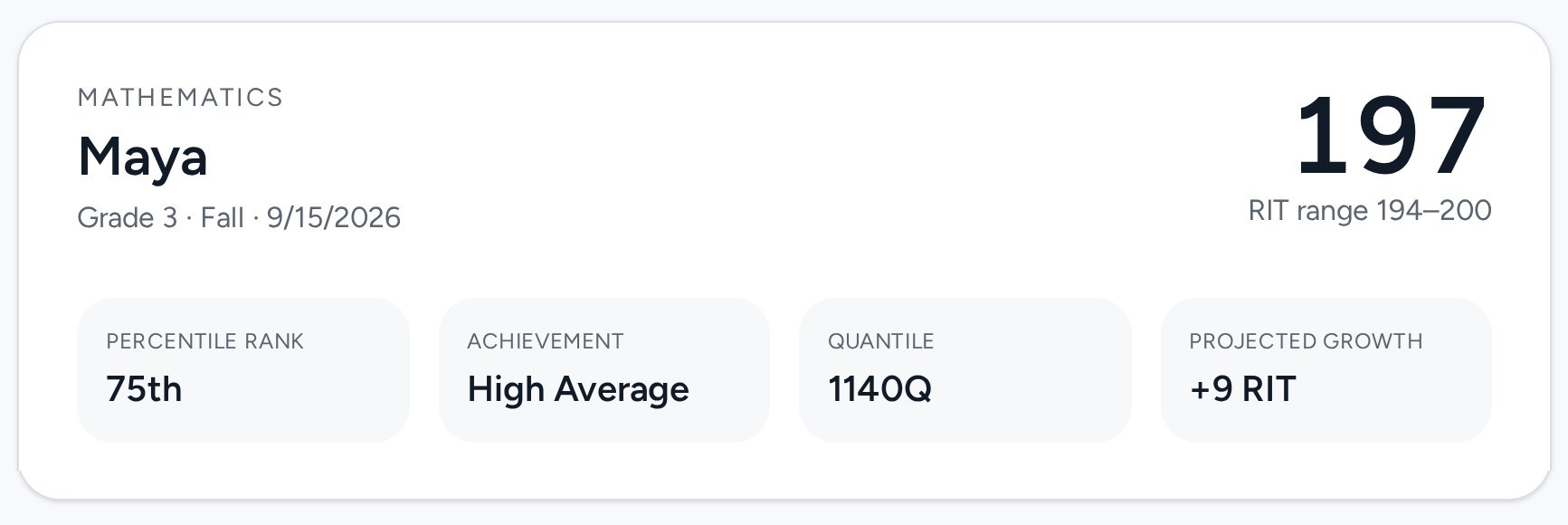
MAP Growth is adaptive. When your child answers correctly, the next question is harder; when they miss, it gets easier. After enough questions, the test settles on the level that matches their ability. That level is the RIT score. Reports also show a small range (for example 198–204), because every measurement has some uncertainty.
What is the RIT score range?
Most students score between about 140 and 240. Kindergartners usually start in the 130s–150s, and scores climb every year. Unlike a percentage, the RIT scale doesn't reset by grade — a 200 means the same thing in grade 3 as in grade 6, which is why it's good for tracking growth over years.
What is a good RIT score?
It depends on grade and season. For example, the average fall math score is about 189 in grade 3 and about 215 in grade 6. See the full MAP score chart by grade to compare.
RIT score vs. percentile vs. growth
- RIT score — your child's level on the scale.
- Percentile — how that score compares with students in the same grade and season nationwide. 60th percentile means they scored higher than 60% of students.
- Growth — how many RIT points they gained between tests. This is often the most useful number for parents.
How to help your child's RIT score grow
The best approach is steady practice at the right level — not cramming. Our guide on how to prepare for the MAP test walks through what helps. Mighty Minds runs adaptive practice that scores on the RIT scale and explains every missed answer in Learning Mode.